

You told your manager you were pregnant, and then things changed. Your hours got trimmed, or the promotion you’d been promised went to someone else, or you were let go a few weeks later with a vague line about “restructuring.” If that sounds familiar, you may be dealing with pregnancy discrimination in California, and the law is more on your side than you might think.
California goes well beyond federal law here. Pregnant workers get accommodations on the job, months of job-protected leave, partial pay while they’re out, and the right to sue for real damages when an employer breaks the rules.
If your employer has five or more employees, it can’t fire you, demote you, cut your hours, refuse to hire you, or treat you worse because you’re pregnant. The same goes for childbirth, breastfeeding, and related medical conditions.
What counts as pregnancy discrimination in California?
In California, the Fair Employment and Housing Act (FEHA) treats pregnancy discrimination as a form of sex discrimination. The protection covers pregnancy, childbirth, breastfeeding, and related medical conditions. It applies to employers with five or more employees, and it protects job applicants as well as current staff. Harassment is off-limits at every employer, even one with a single employee.
In practice, that means your pregnancy can’t be the reason behind a decision about your job. Hiring, firing, pay, promotions, schedules, assignments, and training are all covered.
It often looks like this:
- Getting fired, laid off, or “restructured out” soon after announcing a pregnancy
- A demotion, a pay cut, or a sudden move to a worse shift
- Losing a promotion or a key account because you’ll “be out anyway”
- Comments about your commitment, like “Are you even coming back?”
- Being pushed onto leave when you could keep working with a small change
- A request for lighter duty, more breaks, or a chair refused without a real conversation
- Not getting your job back after leave
- Write-ups that show up out of nowhere after years of good reviews
- No break time or private space to pump when you return
One offhand comment doesn’t always make a case. Timing and patterns usually do. A strong review in January, a pregnancy announcement in March, and a termination for “performance” in April tell their own story.
Reasonable accommodations you can ask for
If your doctor or midwife says you need a change at work because of your pregnancy, your employer has to take it seriously. California requires employers to reasonably accommodate pregnancy and related conditions, and to work with you in good faith to find something that works. Common accommodations include:
- More frequent or longer breaks
- A stool or chair if your job keeps you on your feet
- Relief from heavy lifting or hazardous tasks
- A modified schedule, or time off for prenatal appointments
- A temporary transfer to a less strenuous or less hazardous job, if you ask for it and your provider advises it
Put the request in writing, attach your provider’s note, and keep a copy. If your employer says no without talking through alternatives, that can be a legal problem on its own, and it’s worth reading how a failure to accommodate claim works. Complications such as gestational diabetes or preeclampsia can also qualify as a disability under FEHA, which brings in the same good faith interactive process employers owe to workers with disabilities.
If your employer has 15 or more employees, the federal Pregnant Workers Fairness Act adds another layer. Since June 2023, it has required reasonable accommodations for known limitations tied to pregnancy, childbirth, or related conditions, unless the accommodation would cause undue hardship.
Pregnancy disability leave: up to four months, starting on day one
California’s Pregnancy Disability Leave law, usually shortened to PDL, gives you up to four months off per pregnancy for any time you’re actually disabled by pregnancy, childbirth, or a related condition. The details, from the Civil Rights Department’s PDL fact sheet and its regulations:
- It applies at employers with five or more full-time or part-time employees.
- There’s no minimum time on the job. You can qualify on your first day.
- “Four months” means the hours you’d normally work in four months. For a 40-hour week, that’s 693 hours.
- You can take it all at once or in pieces, like a few hours for appointments or a week of bed rest.
- It covers prenatal and postnatal care, severe morning sickness, doctor-ordered bed rest, childbirth, recovery, and the loss or end of a pregnancy.
- If your employer normally provides group health coverage, it has to keep that coverage going during PDL.
- When you return, you’re entitled to your same job, or in some cases a comparable one. PDL doesn’t shield you from decisions that have nothing to do with the pregnancy, like a genuine layoff.
Give 30 days’ notice when the leave is foreseeable, or as much notice as you can in an emergency. Your employer can require you to use accrued sick leave during PDL. Using vacation is your choice.
If a pregnancy ends in miscarriage or stillbirth, California also provides up to five days of reproductive loss leave, taken within three months of the loss. You need at least 30 days on the job, and your employer needs five or more employees. The rule also covers public employers of any size.
Bonding leave under CFRA, and how it stacks with PDL
Once you’re no longer disabled by the pregnancy, a second law can take over. The California Family Rights Act (CFRA) gives eligible parents up to 12 weeks of job-protected leave to bond with a new child, taken within a year of the birth.
You qualify for CFRA if:
- your employer has five or more employees,
- you’ve worked there for more than 12 months, and
- you’ve worked at least 1,250 hours in the 12 months before the leave starts.
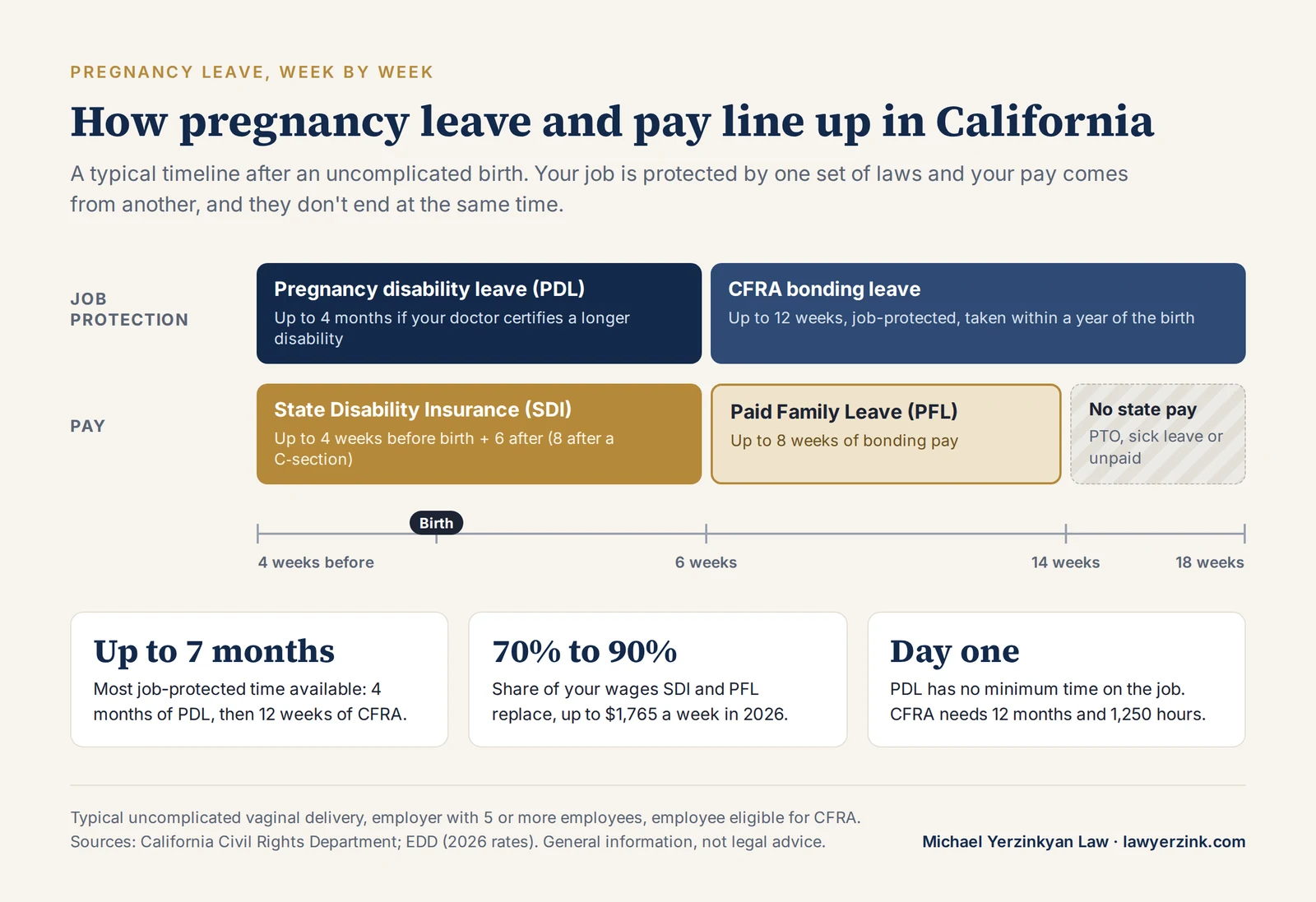
PDL and CFRA are separate rights, so one doesn’t use up the other. That’s why a birth parent who qualifies for both can take up to about seven months of job-protected leave in California: up to four months of PDL, followed by 12 weeks of CFRA bonding leave. Your employer also has to keep your group health coverage in place during CFRA leave. The Civil Rights Department’s CFRA fact sheet walks through the details.
Pay during pregnancy leave in California
Job protection and pay come from different places. PDL and CFRA protect your job, but they don’t require your employer to pay you. The paychecks usually come from two state programs run by the Employment Development Department (EDD):
- State Disability Insurance (SDI) usually covers up to four weeks before your due date and up to six weeks after delivery, or eight weeks after a C-section. Your provider can certify a longer period if there are medical complications.
- Paid Family Leave (PFL) pays up to eight weeks of bonding time. EDD sends the PFL claim form after your last disability payment.
Since January 2025, both programs replace roughly 70% to 90% of your wages depending on your income, with a maximum of $1,765 a week in 2026. Also since 2025, your employer can no longer make you use up to two weeks of vacation before your PFL benefits start.
Keep one thing straight: PFL pays you, but it doesn’t hold your job. The job protection for bonding time comes from CFRA. If you don’t qualify for CFRA, get advice before you commit to a return date.
Your right to pump at work
Your protections don’t stop when you come back. Under California’s lactation accommodation law, your employer generally has to give you a reasonable amount of break time each time you need to express milk, plus a private place to do it that isn’t a bathroom. The space has to be close to your work area, shielded from view, free from intrusion, clean, and safe. It also needs a surface for your pump, a place to sit, and electricity, with a sink and a refrigerator nearby. Employers with fewer than 50 employees can sometimes claim an exemption from the space rules if meeting them would cause undue hardship.
Your employer has to pay you for pumping time that overlaps your paid rest breaks. Extra time beyond that can be unpaid. If your employer refuses, you can file a claim with the Labor Commissioner, and the employer can owe you one extra hour of pay for each workday a break or space is denied. FEHA also protects breastfeeding, so punishing you for pumping can be discrimination too.
When the problem is retaliation
Plenty of pregnancy cases turn on what happened after you asked for something. California law makes it illegal to punish you for requesting an accommodation, taking PDL or CFRA leave, or complaining about discrimination.
Retaliation can look like a string of write-ups that start the week after you ask for light duty, a new schedule that makes prenatal appointments impossible, being left out of meetings, or a termination soon after you return from leave. When the timing lines up that closely, it can say more than any single email. Our page on workplace retaliation covers these claims in more detail.
What to do about pregnancy discrimination in California
You don’t need to have everything figured out to protect yourself. These steps help, whatever you decide to do later:
- Write down what happened while it’s fresh: dates, what people said, and who else was there. Keep your notes at home, not on a work computer.
- Save the texts and emails you sent or received, plus schedules, pay stubs, and performance reviews. Don’t forward confidential company files to yourself, and ask a lawyer first if you’re unsure.
- Ask for accommodations or leave by email, attach your provider’s note, and save the reply.
- If your handbook has a complaint process, use it, and put your complaint in writing.
- Don’t quit on impulse. Resigning can make a case harder unless conditions were truly intolerable, which is the idea behind constructive discharge. Talk to a lawyer before you walk out.
- Don’t rush a severance agreement. California law generally requires your employer to tell you that you can have a lawyer review a separation agreement and to give you at least five business days to do that. Use the time.
Deadlines for pregnancy discrimination claims in California
These are the ones to watch:
- You generally have three years from the last harmful act to file a complaint with the California Civil Rights Department (CRD). You need a right-to-sue notice from CRD before you can sue under FEHA, and you can ask for one right away if you plan to go to court.
- After CRD issues a right-to-sue notice, you generally have one year to file your lawsuit.
- For federal claims, you generally have 300 days to file an EEOC charge in California.

Don’t count on the full three years. Coworkers leave, old texts disappear, and some related claims have shorter deadlines.
What a pregnancy discrimination claim can be worth
If your employer broke the law, FEHA allows you to recover:
- lost wages and benefits, both past and future
- compensation for emotional distress
- punitive damages, if you can show by clear and convincing evidence that a company officer, director, or managing agent was behind or approved conduct involving malice, oppression, or fraud
- attorney’s fees and costs, which the court can order the employer to pay if you win
Under federal law (Title VII and the ADA), emotional distress and punitive damages are capped at a combined $50,000 to $300,000, depending on the employer’s size. FEHA has no such caps.
Big verdicts are rare, and they don’t predict what any one case is worth. In one well-known case (not ours), a federal jury in San Diego returned a verdict of nearly $186 million in 2014, almost all of it punitive damages, for Rosario Juarez, a longtime AutoZone employee and former store manager who said she was demoted after she became pregnant and later fired. The parties settled privately the next year and never disclosed the amount. Most cases resolve for far less, and the value depends on the facts. We explain how that value is calculated in our guide to wrongful termination settlements in California.
Frequently asked questions
Can you be fired for being pregnant in California?
No. At employers with five or more employees, firing someone because of pregnancy, childbirth, breastfeeding, or a related condition is illegal. An employer can still fire a pregnant employee for a legitimate reason that has nothing to do with the pregnancy, such as a real layoff or documented misconduct. When the reason shows up right after the announcement, or the explanation keeps shifting, it deserves a closer look.
Do I have to tell my employer I’m pregnant?
Not until you need something from them, like an accommodation or leave. When leave is foreseeable, give 30 days’ notice if you can. Plenty of people wait until after the first trimester, and that’s your call.
Can an employer ask if I’m pregnant or planning to have kids?
Generally, no. FEHA bars non-job-related questions that point toward discrimination based on sex, and pregnancy counts as sex under the law. Questions about pregnancy or family plans rarely have anything to do with the job. If an interviewer asked and you didn’t get the offer, write down exactly what they said and when.
Can my employer force me to go on leave?
Generally not, if you can still do your job with or without a reasonable accommodation. The federal Pregnant Workers Fairness Act specifically bars covered employers from requiring leave when another reasonable accommodation would work. Being pushed onto leave early can also eat into the four months of PDL you might need later.
Is pregnancy disability leave paid?
PDL itself is unpaid unless your employer has a policy that pays for it. Most people are paid through State Disability Insurance, plus any sick leave or PTO they have.
What if my employer has fewer than five employees?
PDL, CFRA, and most FEHA discrimination rules won’t apply, but harassment is still illegal. You may still be able to collect SDI and Paid Family Leave, because eligibility depends on your own payroll contributions, not on your employer’s size.
Talk to a pregnancy discrimination lawyer in California
If you were fired, demoted, pushed out, or denied leave around a pregnancy, you don’t have to figure out on your own whether it was pregnancy discrimination under California law. Michael Yerzinkyan Law represents employees in Los Angeles and throughout Southern and Central California in pregnancy discrimination, retaliation, and wrongful termination cases.
Call 213-725-2200 or contact us online to set up a free consultation. You can also read more about how we handle pregnancy discrimination cases in Los Angeles.
This article is general information about California law as of September 2026. It isn’t legal advice, and reading it doesn’t create an attorney-client relationship.