

If you were fired and think it was illegal, one question comes up fast: what is this worth? Search for the average wrongful termination settlement in California and you’ll find confident numbers everywhere. $40,000. $100,000. “Six figures.” Most of those numbers aren’t based on much.
Nobody has a reliable average, because most settlement amounts are private. What we do have are public figures from the agencies that handle these complaints, plus the legal rules for calculating damages. Together, they tell you far more about where a case might land than any single “average” can.
Why there’s no reliable average
California law lets a settlement agreement keep the dollar amount confidential. But once you’ve filed a claim in court or with an agency, the agreement can’t stop you from sharing the facts of workplace harassment or discrimination, or of retaliation for reporting it. So when a wrongful termination settlement is reached in California, the facts may come out, but the number usually stays private. There’s no public database to average.
The figures you see online tend to come from three places: famous jury verdicts, a law firm’s own results, or national surveys. Verdicts are the least useful guide. They’re rare, they involve extreme facts, and many shrink after trial or end in a private settlement.
Take the AutoZone case. In 2014, a federal jury in San Diego awarded a former store manager nearly $186 million in a pregnancy discrimination case, almost all of it punitive damages. The parties resolved the case privately the next year, and neither side disclosed the final payment. A headline like that shows what a jury can do in an extreme case. It tells you almost nothing about what a typical case settles for.
What the public data actually shows
The best public numbers come from government agencies, and they show how misleading a simple average can be.
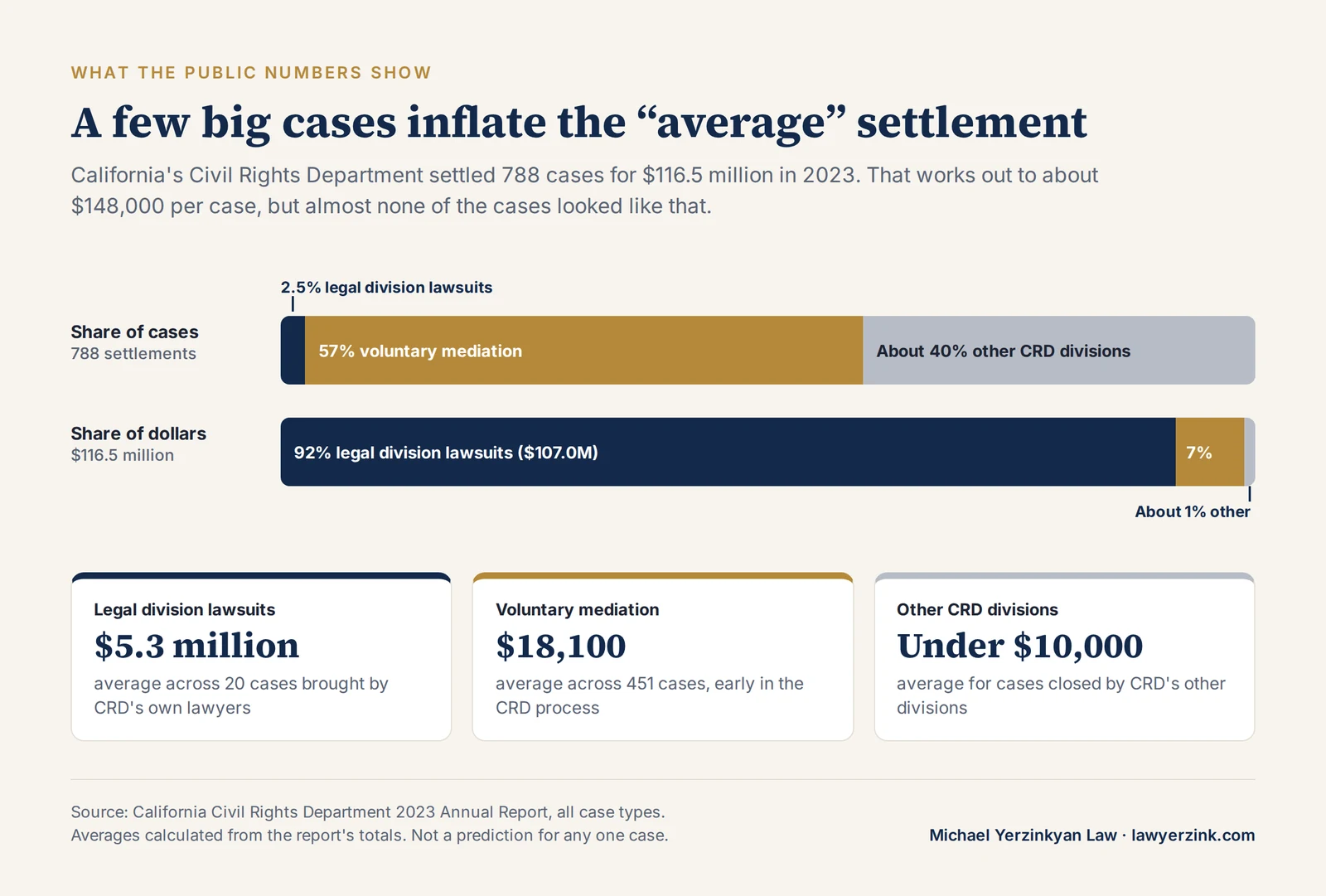
In 2023, California’s Civil Rights Department (CRD) secured $116.5 million across 788 settlements, according to its 2023 annual report. Divide one by the other and you get about $148,000 per case. But 20 cases handled by CRD’s legal division brought in nearly $107 million of that total. The 451 cases resolved through CRD’s voluntary mediation program averaged about $18,100 each, and cases closed by CRD’s other divisions averaged well under $10,000. Those figures cover every type of case CRD handles, not just employment.
Federal numbers point the same way. In fiscal year 2025, the EEOC resolved 7,929 charges through mediation for about $245.3 million, roughly $31,000 per case, according to its FY 2025 performance report.
Agency mediations usually happen early, often before anyone has hired a lawyer or exchanged much evidence. Cases that go through a lawsuit, with depositions and document requests, can settle for considerably more. They can also end with nothing if the evidence falls apart.
A small number of big cases drags the “average” up. What your case is worth depends on your facts, not on anyone else’s number.
What goes into a wrongful termination settlement in California
A settlement is a negotiated guess at what a jury might award, discounted for the risk and cost of getting there. So it helps to know what a California jury can actually award.
Back pay
Back pay covers the wages and benefits you lost from the day you were fired until trial or settlement, minus anything you earned elsewhere in the meantime. Benefits count too: health insurance, retirement contributions, bonuses, commissions, and stock you would have received.
Front pay
If you’re still earning less than before, or can’t find comparable work, a jury can award the difference for a reasonable period into the future.
Emotional distress
This covers anxiety, lost sleep, humiliation, and the stress of losing your income. You don’t need a diagnosis to recover these damages, but treatment records and testimony from people close to you make them more concrete.
Punitive damages
Punitive damages exist to punish. They’re only available if you prove, by clear and convincing evidence, that the employer acted with malice, oppression, or fraud. For a company, that generally means an officer, director, or managing agent was behind the conduct or approved it, under Civil Code section 3294.
This is one reason California claims can be worth more than federal ones. Under Title VII and the ADA, emotional distress and punitive damages are capped at a combined $50,000 to $300,000, depending on the employer’s size, while back pay isn’t capped. FEHA has no caps at all.
Attorney’s fees and costs
Under California’s Fair Employment and Housing Act (FEHA), a court can order the employer to pay your attorney’s fees if you win. That exposure grows every month a case goes on, which gives employers a real reason to settle.
Statutory penalties
Some claims add statutory penalties. A whistleblower retaliation claim under Labor Code section 1102.5, for example, allows a civil penalty of up to $10,000 per violation.
Example: how a wrongful termination settlement adds up
Dana isn’t a real client, but her made-up case shows how the math behind a wrongful termination settlement in California works.
Dana worked as an operations manager in Ontario, California, earning $78,000 a year plus about $600 a month in health and retirement benefits. Three weeks after she asked for medical leave for surgery, she was fired for “attitude problems,” despite years of good reviews. She spent eight months looking for work and landed a similar job paying $70,000.
| Piece of the claim | How it’s figured | Dana’s numbers |
|---|---|---|
| Back pay | 8 months × $6,500 | $52,000 |
| Lost benefits | 8 months × $600 | $4,800 |
| Front pay | $8,000 a year pay gap × 2 years | $16,000 |
| Emotional distress | Set by a jury, varies widely | Say $75,000 |
| Total if Dana wins | $147,800 |
We made up Dana’s numbers to show the math. A real case can be worth more, less, or nothing.
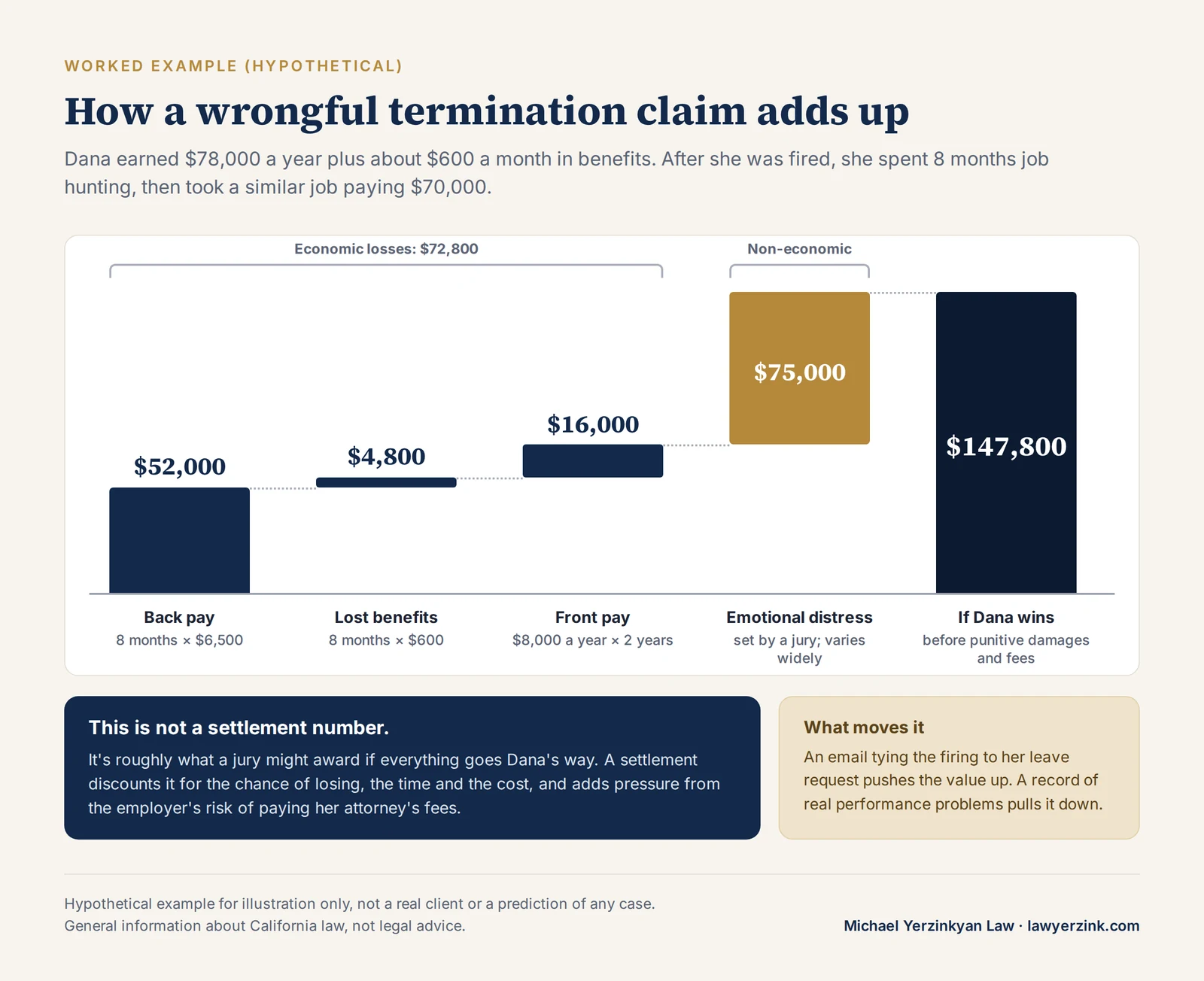
That $147,800 isn’t a settlement number. It’s roughly what a jury might award Dana if everything goes her way at trial, before any punitive damages or attorney’s fees. A settlement discounts that figure for the chance of losing, the time it takes, and the cost of getting there. It also reflects pressure on the other side: if Dana wins, the court can order the employer to pay her lawyer’s fees too, and after a long case those can rival the damages themselves.
If both sides see her chances at trial as good but not certain, the case might settle well below $147,800 and well above what a quick agency mediation would produce. Strong evidence, like an email tying the firing to her leave request, moves the number up. A documented history of real performance problems moves it down.
What pushes a settlement up
- Clear evidence linking the firing to something illegal, like an email, a text, or a manager’s comment
- Tight timing between a protected act (a complaint, a leave request, a pregnancy announcement) and the termination
- Explanations for the firing that keep changing
- Coworkers outside your protected group who did the same thing and kept their jobs
- A strong work history with good reviews, raises, and no discipline
- Higher pay and a longer stretch out of work
- Real, documented emotional harm
- Conduct by senior managers that could support punitive damages
- A lawsuit that’s moving toward trial, with fee exposure growing
What pulls a settlement down
- An arbitration agreement, which sends the case to a private arbitrator instead of a jury
- Finding a comparable job quickly
- A documented history of performance problems or discipline
- Gaps or contradictions in your account
- A missed filing deadline, or a signed release of claims
- An employer with little money or insurance to pay a judgment
- A thin job search after the firing
That last point trips people up. California expects you to make reasonable efforts to find comparable work after you’re fired. If the employer proves that substantially similar jobs were available and you didn’t make reasonable efforts to seek them, your lost-wage damages can be reduced by what you could have earned. Keep a simple log of every job you apply for.
How long does a wrongful termination settlement take in California?
Some cases settle within a few months, sometimes before a lawsuit is even filed, when the evidence is strong and the employer wants to avoid litigation. Others take a year or more. A typical path looks like this:
- You file a complaint with CRD and get a right-to-sue notice. You can ask for one right away if you plan to go to court.
- Your lawyer files the lawsuit, usually in superior court, within one year of that notice.
- Both sides exchange documents and take depositions.
- The parties meet with a neutral mediator, where many employment cases settle.
- If the case doesn’t settle, it goes to trial.
How much of a California wrongful termination settlement you keep
The settlement number isn’t what lands in your bank account. Three things come out first.
First, attorney’s fees. Most lawyers who represent employees work on contingency, taking a percentage of the recovery (often somewhere between a third and 40%) and no fee if you lose. Ask about the percentage before you sign a fee agreement.
Then there are costs. Filing fees, deposition transcripts, experts, and mediators add up. Costs are a separate question from the fee, and some agreements require you to repay them even after a loss, so ask how they’re handled.
And then taxes. According to IRS Publication 4345, the part of a settlement that replaces wages is taxed as wages, with withholding. Emotional distress damages that don’t come from a physical injury are generally taxable too, and so are punitive damages. Under Internal Revenue Code section 62(a)(20), fees in most employment cases can be deducted “above the line,” up to the settlement income you report, so you generally don’t pay income tax on your lawyer’s share. How the settlement splits between these categories matters, so talk to a tax professional before you sign.
Read any severance agreement before you sign it
If your employer offers severance on the way out, it almost always comes with a release of any claims you might have. Once you sign, your case is usually over. A few rules help:
- California law generally requires your employer to tell you that you can consult a lawyer about a separation agreement and to give you at least five business days to do it.
- If the agreement has a non-disparagement or confidentiality clause, it has to make clear that you can still talk about unlawful acts at work, like harassment or discrimination.
- If you’re 40 or older and your employer has 20 or more employees, a release of federal age discrimination claims is only valid if you get at least 21 days to consider it (45 days in a group layoff) and 7 days to change your mind after signing.
A severance offer can also be a starting point. If you have a strong claim, a lawyer may be able to negotiate a better number before you sign anything.
Deadlines for wrongful termination claims in California
- CRD complaint for discrimination, harassment, or retaliation under FEHA: generally three years from the last harmful act
- Lawsuit after a right-to-sue notice: generally one year from the date of the notice
- Wrongful termination in violation of public policy: generally two years from the firing
- EEOC charge for federal claims: generally 300 days in California
These are general rules, and there are exceptions. Some claims against government employers, for example, have much shorter notice requirements. Don’t wait to find out which rules apply to you.
Frequently asked questions
Is there a wrongful termination settlement calculator for California?
Online calculators can help you think about lost wages, but they can’t weigh the things that decide most cases: the strength of the evidence, how credible the witnesses are, and whether you signed an arbitration agreement. Use them as a rough starting point and nothing more.
Can I get emotional distress damages without seeing a therapist?
Yes. Your own testimony, and testimony from family and friends, can support emotional distress damages. Treatment records, when they exist, usually make the claim stronger.
Does filing a lawsuit increase a wrongful termination settlement?
It can. A filed case with a trial date puts pressure on the employer, especially because FEHA can require it to pay your attorney’s fees if you win. It also adds time, cost, and risk for you, so it’s a strategic call to make with your lawyer.
Will my case go to trial?
Probably not. Most employment cases settle before trial, often at mediation. Still, a case is only worth what it would be worth in front of a jury, so it has to be prepared as if it’s headed there.
What if I quit instead of getting fired?
If your employer made conditions so intolerable that a reasonable person would have felt forced to resign, you may have a constructive discharge claim, which is treated like a firing. These cases are harder to prove, so talk to a lawyer before you resign if you can.
Talk to a California wrongful termination lawyer
Every wrongful termination settlement in California comes down to the facts, and no article can tell you what yours is worth. An employment lawyer can review your situation and explain your options. Michael Yerzinkyan Law represents employees in wrongful termination, discrimination, and retaliation cases in Los Angeles and throughout Southern and Central California.
Call 213-725-2200 or contact us for a free consultation. If you’re still figuring out whether your firing was illegal in the first place, start with our guide to what counts as wrongful termination in California, or read more about our wrongful termination practice.
This article is general information about California law as of September 2026. It isn’t legal advice, and reading it doesn’t create an attorney-client relationship.